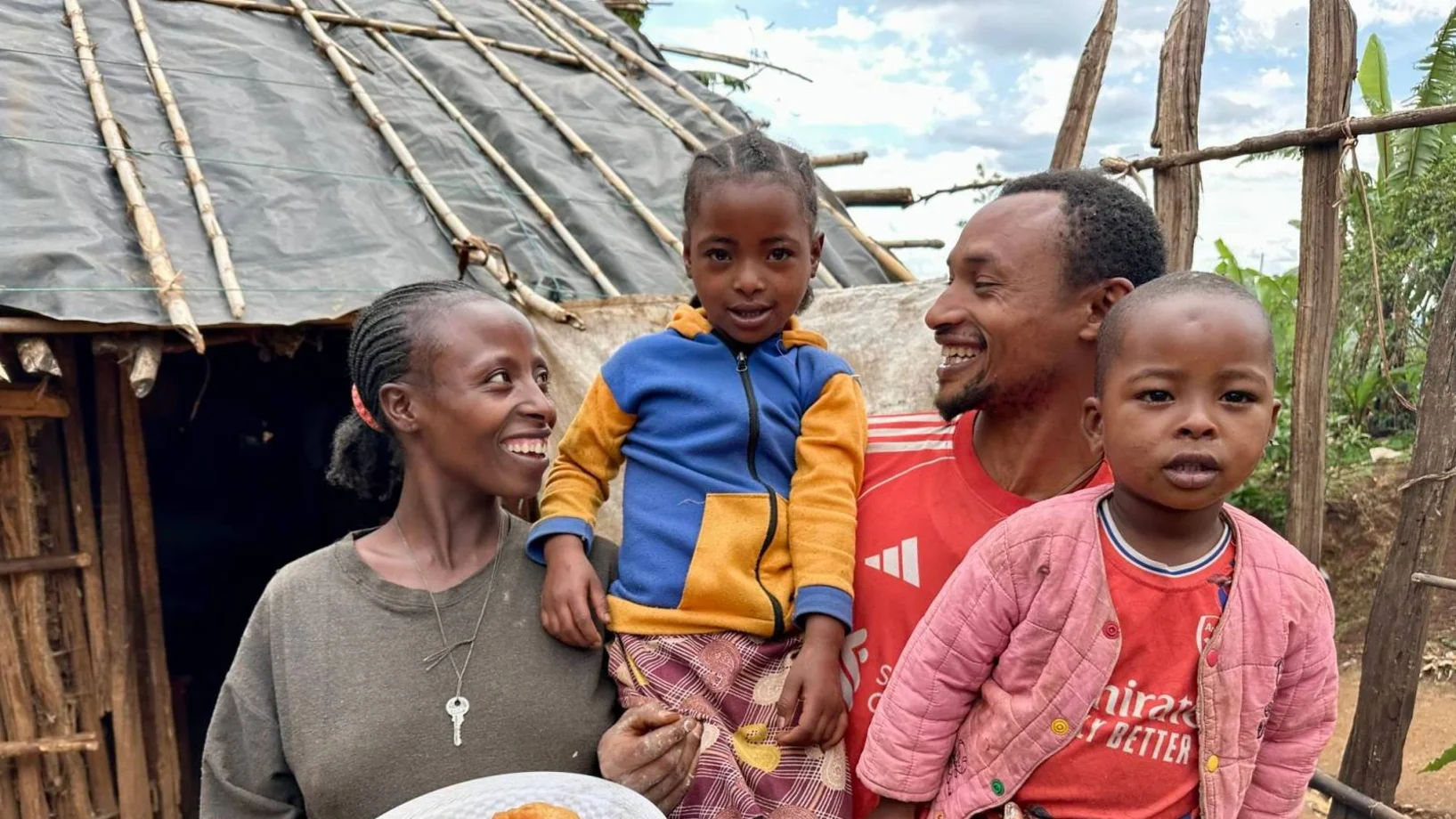
Worku Alemu owns very little land and earns a few centimes by repairing umbrellas. Now this father is counting on a much more lucrative source of income: five new beehives.
Suddenly, rain begins to patter on the roof – an afternoon downpour. Moments later, water starts dripping from the ceiling. Worku Alemu grabs an umbrella and holds it over his visitor from Switzerland so the ink in his notebook doesn’t smudge.
Worku knows a thing or two about umbrellas. Women, in particular, carry them on the long walks between their small farms and the market – not only as protection from the rain, but above all from the scorching sun. Worku is trying to turn this into a small business. On market days, he sits among women selling smuggled secondhand clothes from Kenya or a few cloves of garlic and potatoes, waiting for customers.
He doesn’t have a toolbox. He has just one tool: a simple pair of pliers. “I use these to repair umbrellas.” The craft runs in the family. His father and older brothers taught him how to straighten bent ribs and restore broken umbrellas to working order. Worku earns up to 50 birr doing this on a market day. That’s the equivalent of about 25 rappen.


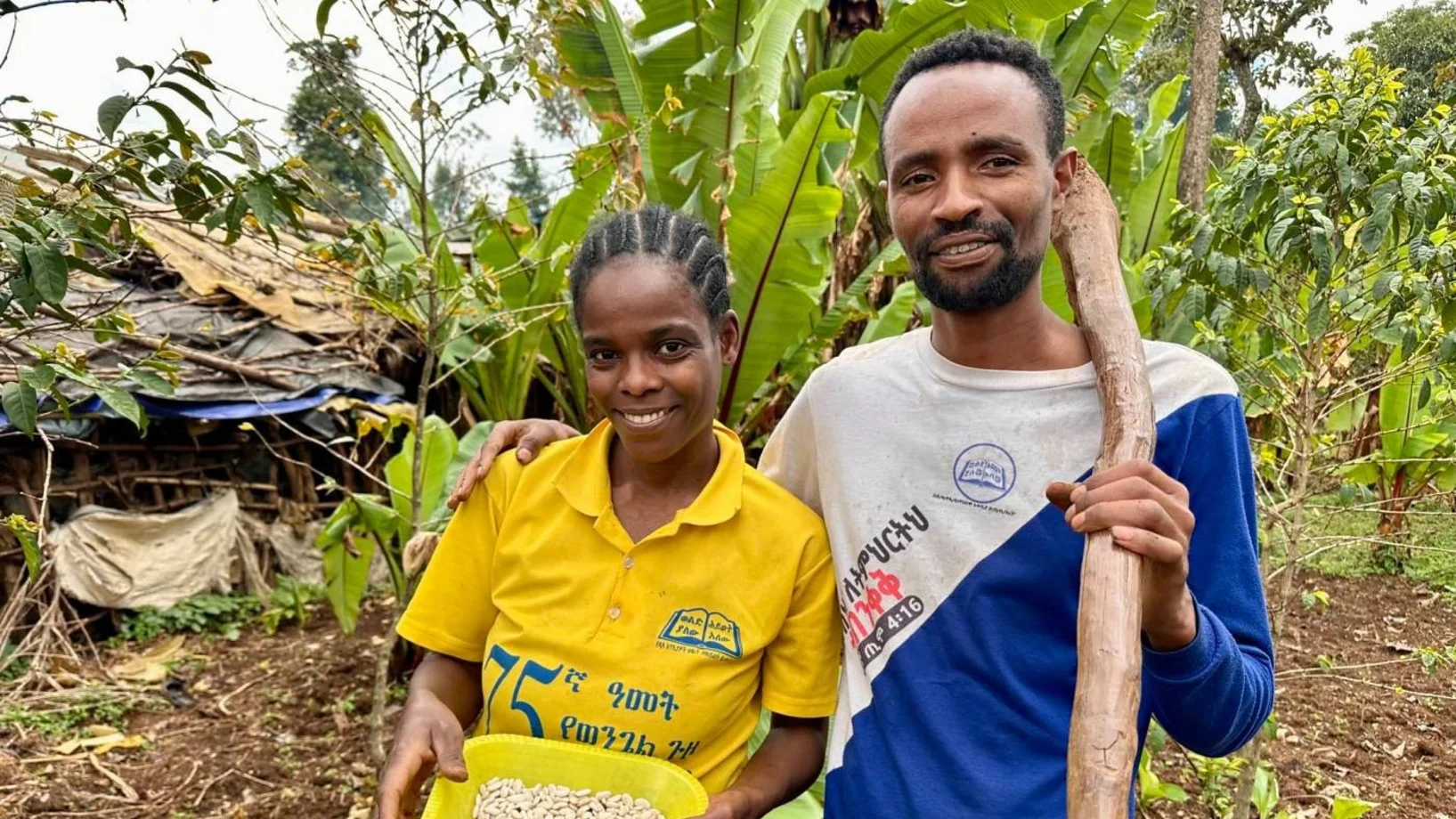
The 35-year-old lives with his wife, Tsehaynesh, and their four children in Raphe, in southern Ethiopia. Their home is a simple tukul, a traditional round hut. There are large gaps between the wall posts, and the roof is covered only with leaves from the ensete plant. There are no beds. The family sleeps on dried ensete leaves. A small solar panel sits on the roof – the only visible sign of the 21st century. It provides power for an old Nokia cell phone.
The youngest daughter, Meseret, is three years old. She wears a plastic shoe on her left foot; on her right, she walks barefoot. Her siblings, too, have hardly any clothes. The parents have a few changes of clothes. “We only wear them on Sundays when we go to church,” says Worku.
Food is also scarce. The family doesn’t have money for coffee beans. Instead, Tsehaynesh brews a decoction from the husks of coffee cherries in the morning. They eat a few field beans with it. There’s no lunch. In the evening, the family usually eats cabbage with kocho, a bread-like staple made from the starchy enset plant. When Worku earns a little money at the market, he sometimes brings home a few tomatoes or potatoes. They never have meat.
Worku has only a quarter hectare of land. It’s mostly planted with enset, with cabbage and beans growing in between. He also makes baskets out of bamboo. He takes every opportunity to earn a little money. That’s why he’s been keeping bees for quite some time.
Worku built his five traditional beehives himself out of twigs and sealed them with clay. He hangs them high up in the trees – hoping that a colony of bees will move in. If he’s successful, the dangerous work begins: If Worku wants to check whether the honey is ready to be harvested, he has to climb up. Harvesting is also often done high up in the tree, usually at night or early in the morning, when the bees are less aggressive. Stings and falls are a constant risk.


The harvest itself is also laborious. Worku must retrieve the traditional beehive from the tree and open it completely. Because the bees build their combs firmly against the inner wall, they are cut out during the harvest. This destroys the hive.
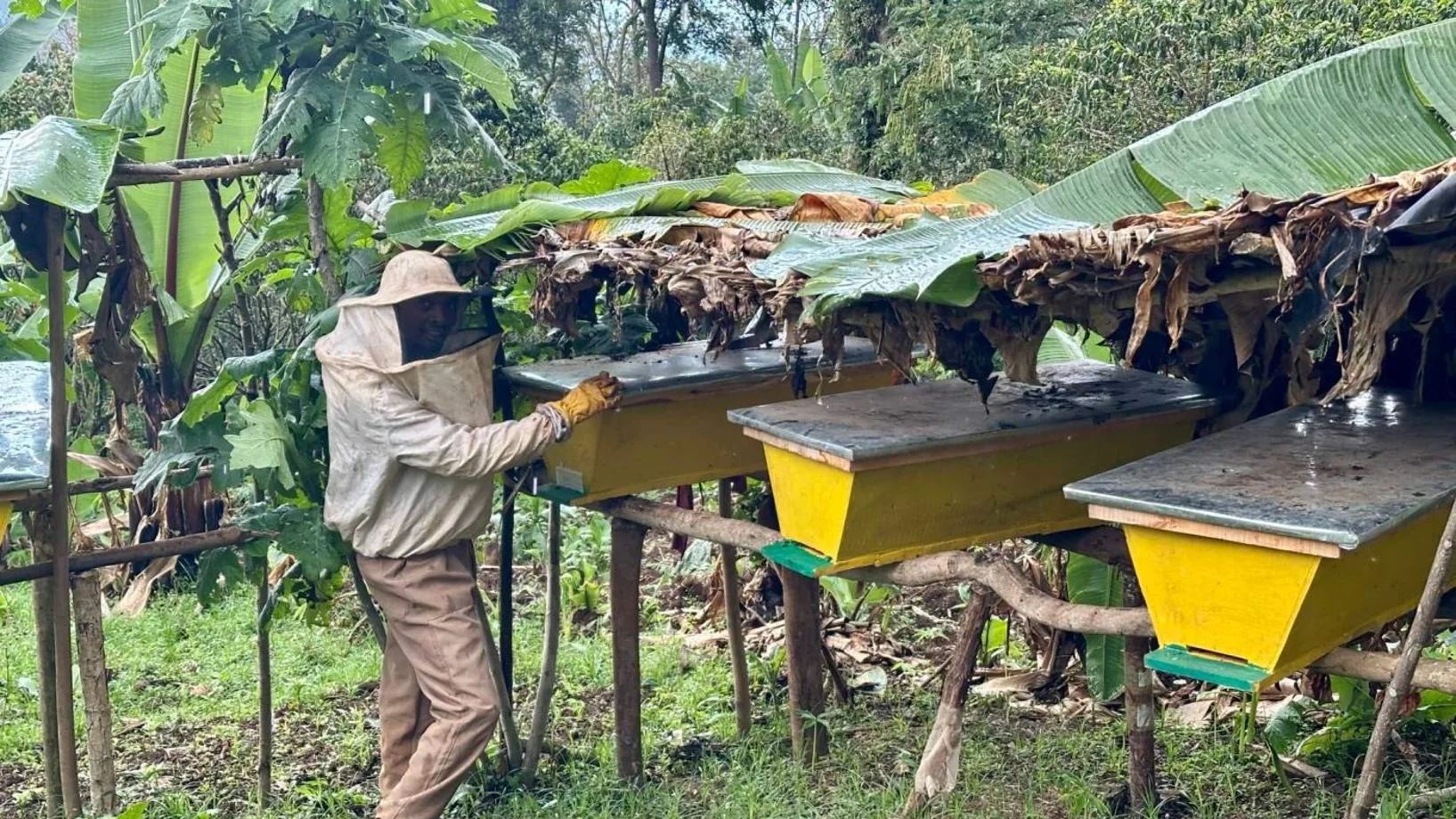
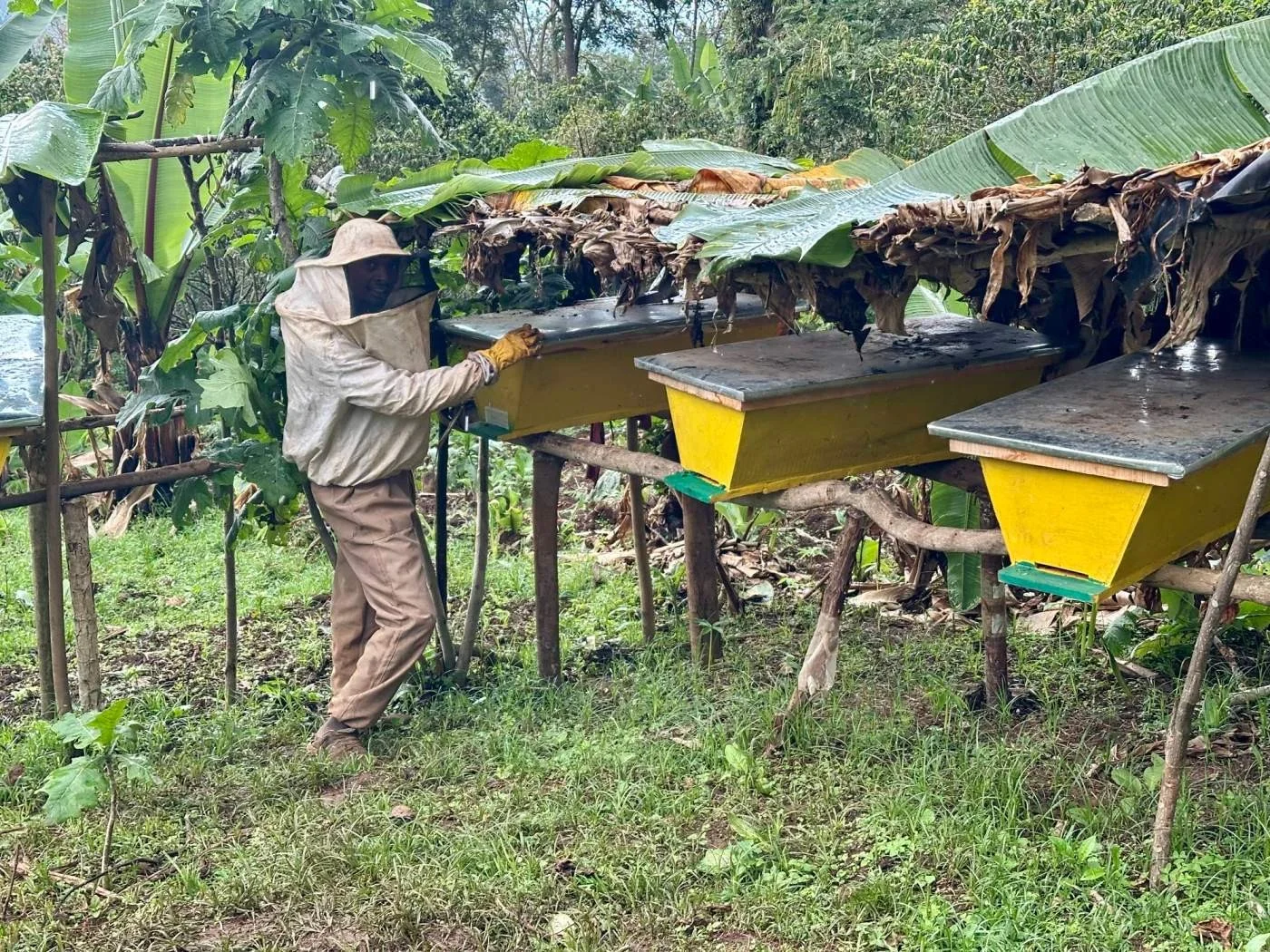
According to local experts, a traditional hive typically yields only four to six kilograms of honey per year. Menschen für Menschen therefore equipped Worku with five new beehives and trained him for three days on how to use them. He transferred one bee colony from each of his old hives into one of the new hives.
The hives stand on racks on the ground. Inside, individual wooden slats are placed crosswise across the hive. The bees build honeycombs on each one. Worku can lift the slats out individually to check how the colony is developing and whether the honey is ready for harvest. During harvest, he can selectively remove combs with ripe honey without destroying the brood combs.
This makes beekeeping easier and safer – and significantly increases the yield. According to local experts, the new hives yield about 15 to 20 kilograms of honey per colony per year – several times more than traditional hives. For Worku, the numbers seem to add up: he has already harvested one of his five hives. He collected four buckets, totaling about 20 kilograms of raw honey – a mixture of honey and honeycomb. There is a large market for this in Ethiopia: raw honey is primarily used to make tej, the traditional Ethiopian honey wine.


Worku could currently get about 2,500 birr (just under 13 francs) for a bucket. But he’s waiting. “Many beekeepers have just harvested, so there’s a lot of honey on the market,” he says. “When there’s less honey on the market, I can get 3,000 birr for it.”
A comparison illustrates what this means for him: To earn the equivalent of a single bucket, Worku would have to repair umbrellas for 60 days.
A single beehive has yielded him four buckets. Worku could actually harvest the remaining four hives now. But he has decided against it for the time being. “The blooming season for many plants is over. If I harvest all the honey now, they’ll have nothing left to eat,” says Worku. He plans to harvest again only when enough plants are blooming once more and the bees can build up new stores. Normally, he says, he can harvest honey twice a year – in March and June.
In the training program of “Menschen für Menschen”, Worku learned to observe his bee colonies and weigh his options: How much honey can he take from them? How much do they need for themselves? And when is the right time to harvest?
Yet the family could really use the money right now. The roof needs to be replaced, and the walls need to be sealed. A bed would be a step in the right direction. Later, Worku would also like to buy a sheep or a goat. But first, there’s something else. “For now, my earnings will go toward better nutrition for our children,” he says.
On the day he sells his first batch of honey from the new hives, he’ll treat his family to a little luxury: “Then I’ll definitely buy some meat, too.” It will be a rare feast.